


RAMAYANA MOVIE: PERISCOPE…Guest Author Prof. Satish Bhatnagar, Ph.D.
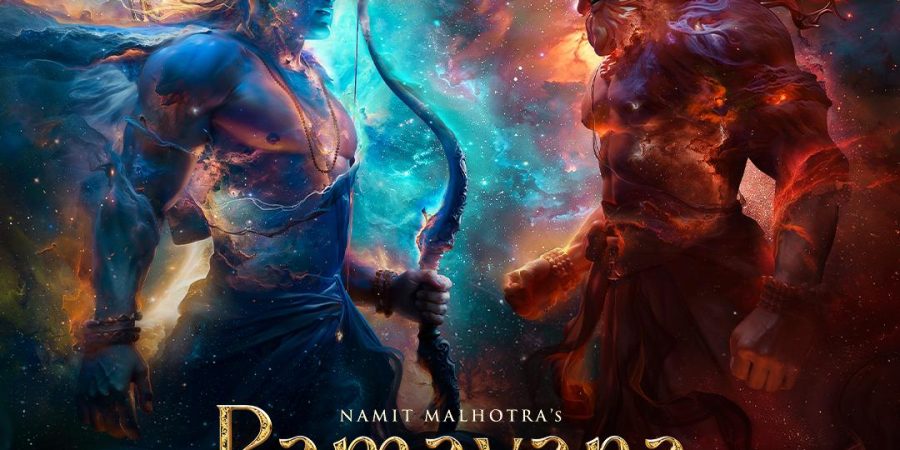
The Part I (Part II to be released on 11/28) of the latest Ramayana movie was released globally on November 5 – a week ago. The producers have spent nearly 25% of the budget on every advertising outlet wherever the Indian Diaspora is there. For a number of reasons the promotion of any product, the US is the advertising target of every nation. In fact, the Hindus especially follow the lifestyles, business models, and entertainment norms of the US – earlier, it used to be the UK. This point was made by my wife who has been head over heels in praise of the movie after watching its snippets and trailers on her iPad.
Well, I saw this movie yesterday and on telling my wife what I thought of it was worthy of this reflection. I believe that what kind of life one has lived for 80-some years, if one can’t qualitatively discriminate in the routine aspects of life like, food, apparels, books, movies etc. This movie was nearly 200 minutes long. Knowing my bladder, I emptied it just before entering the theater, in the middle of the movie (no intermission), and then right after I came out of the theater. Here are my unordered takes on the movie:
1. The movie begins with a chronology of Ramayana. As a published historian, I have come to the conclusion that out of all the followers of major religions, Hindus have the least interest in making history, preserving history, reading history, and writing about history. Consequently, they are least bothered if some so-called scholars distort their heritage. There are a number of reasons for it – the main one being their having lived in political servitude for 7-8 centuries (before 1947). They have no qualms about living in holes as second class citizens in their homeland. The Ramayana era lies in the 9th century BC followed by the Mahabharata era in the 8th century BC, and then comes Buddha in the 5th. For a perspective on a timeline, look at the events in any span of 100 years, say in the US between 1920 and 2020 – territory doubled, automobiles, planes, landing on the Moon, computers, internet, iPhones, driverless cars, and Mars exploration etc The movement of Time and human curiosity remains constant.
2. The movie opened with the mother of Ravana exhorting him to awaken his people from a long bondage in their home country. Immediately, I connected it with the RSS, VHP, and Modi awakening the Hindus from their political slumber of centuries. But quickly, the story, the sets, and direction turned into the fantasies of rakshashas, yakshas gandharavas, and devas– completely disconnected with the present-day life. Yes, it strengthens superstitions amongst the Hindus. Is it good? In the US culture where movies like ET, Spiderman, Lion King have set records at the box office, these Ramayana scenes may fit into that genre. However, it is too much to stomach them scene after scene.
3. I recalled the movies of religious themes that I saw in my teens (1950s) in Bathinda, my hometown in India. Each Indian movie had exactly the same approach of actions, sound effects, light effects and dramatizations. They have only changed in sophistication due to technological advancement – but not in the essence behind actions.
4. The acting was good. Often I say one can do a good acting in the very first take of a scene as all it requires is to know the character fully and emotionally, and assume its identity during a shoot. I do not mean to trivialize acting. A few days ago, I expressed myself in a Hindi love song (kabhi kabhi mere dil mein khayal…..) in the family Diwali celebration.
5. The movie perpetuates the evil of the Hindu caste system based on birth. How the hell is Parshuram a brahmin when he had killed the kshatriyas 20 times? He is not a brahmin; he is a warrior – a kshatriya. That implies kshatriyas are fighting with each other fanning no unity amongst the Hindus at large. What a message that has seeped into the Hindu mindsets for the next millennia! It reminds me of an 84-year old distant relative who lost her 95-year old husband a week ago. As a part of bringing closure to the mourning rituals, she fed a brahmin at her residence, and sent packed lunches to the homes of 12 other brahmins! This is the ultimate example of sticking to the birth-based caste system. Abolishing untouchability by a law may have been successful to some extent, but not in eradicating the bane of the Hindu caste system by birth. The fact of life is that daily every person services at home like a shudra, professes like a vaishya, ponders over life like a brahmin, and fights like a kshatriya for the honor of his faith, family or nation. This movie disunites the Hindus at a time when the global forces are trying to break India apart. The director unknowingly has played into the hands of the avowed breakers of India.
6. During the last 20 years, I have extensively written on the trilogy or the pillars of education coming straight from the Ramayana era – they are shaastra/ शास्त्र (knowledge of the heritage) shastra/शस्त्र (art of war), and shatru/शत्रु (enemy within and without). I was pleased to see that Sita too was well-versed in all three coordinates of education. She demonstrated her bravery in a battle. Islam has these three pillars – and look at its growing power since its advent in the 7th century. Also, it reminds me of Guru Gobind Singh who created Khalsa (1699), the faith fighters out of ordinary men, women, and children – all ordained to carry a dagger wrapped across a shoulder. It is the martial form of the janeu/जनेऊ , a three-strand cotton thread that Hindus wear underneath their garments. (Googleable)
7. Songs, integral parts of Hindi movies, were totally absent as I try to recall! However, after the movie was over, during various acknowledgments etc, the Hanumaan Chalisa of Tulsi Das was played, and a song followed it. In fairness, there was no other place to insert these songs in the movie.
8. Finally, despite all the advertising, the number of people in the cinema hall was only eight! Yesterday was a federal holiday, and there are nearly 16,000 people from India living in metropolitan Las Vegas. That tells you something about the movie.
9. That is all about the movie Ramayana for the time being. My final grade for this movie is a B Minus. If anyone wants to get a good and realistic understanding of the epic of Ramayana, then either listen to the videos of Kumar Vishwas on YouTube or read it in the three volumes in Hindi written by Narendra Kohli. (Googleable). To the best of my knowledge, there is no Ramayana in English that is comparable to these two sources.
Satish C. Bhatnagar, PhD
November 12, 2026
Satish C. Bhatnagar, Ph.D., Professor, Department of Mathematical Sciences, University of Nevada, Las Vegas, NV 89154 Phone: 702-895-0383 Email: bhatnaga@unlv.nevada.edu
Adjunct Professor, Central University of Punjab, Bathinda (2019 – ) UNLV Faculty Senate (2018 – 2021)
The views, thoughts, and opinions expressed in the above article solely belong to author Dr. Bhatnagar, and are not an endorsement by vegasdesi.com. The editor is pleased to provide vegasdesi.com as a platform for the community members to engage in intellectual debates, opinions, constructive criticisms, and discussions.
Related News

Assemblyman Reuben D’Silva Re-Introduces Legislation to Make Diwali, the Eid, Vaisakhi, and Vesak (the Buddha’s Birthday) Official Days of Observance in Nevada
On the auspicious occasion of Diwali, NV State Legislator Indian-American Reuben D’Silva announced today that he hasRead More

